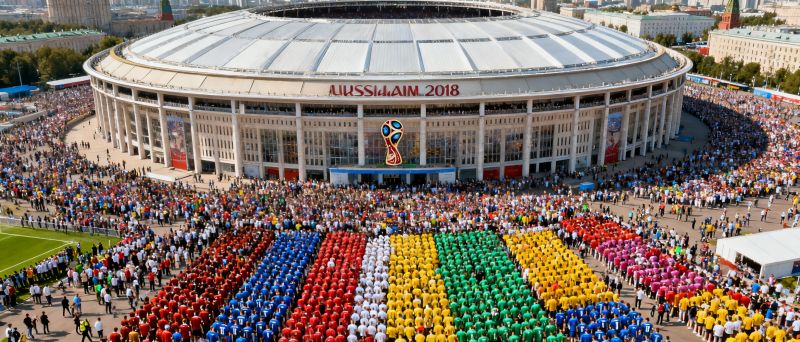
he 2018 World Cup wasn't just a tournament;it was a sprawling geography lesson. Eleven host cities。stretching from the Baltic Sea to the Ural Mountains, turned Russia into a live map of football fever. I still remember the buzz in Moscow's Gorky Park after Spain's shock exit—fans from Iran and Portugal mingling, arguing, laughing. That's the thing about the 2018 World Cup locations: they weren't neutral backdrops. Each city stamped its personality on the games.Start with Moscow, the gravitational center. Luzhniki Stadium hosted the opener and the final, its 78,000 seats a cauldron of noise. But the real Moscow experience was outside the ground—the metro rides packed with Colombian yellow and Croatian checkers。
the impromptu samba drums near Red Square. Then there's Saint Petersburg, a city that feels like a museum with a football problem. Krestovsky Stadium, floating on the Gulf of Finland, hosted that Belgium-Japan thriller. Locals told me they loved the games but hated the traffic. Fair enough.Sochi deserves a special mention. The Fisht Stadium, built for the 2014 Winter Olympics, looked bizarre hosting summer football—palm trees outside, snow-capped peaks in the distance. I watched Germany's collapse against South Korea there, and the stunned silence from German fans was louder than any chant. Nizhny Novgorod and Samara offered a different vibe: smaller, grittier。with stadiums that felt intimate. Volgograd, formerly Stalingrad, had the most haunting pre-match atmosphere—the Mamayev Kurgan memorial looming over the city, a reminder of history far heavier than a game.What struck me most about the 2018 World Cup locations was how they forced fans to confront Russia's sheer scale. A flight from Kaliningrad to Yekaterinburg takes over four hours—longer than London to Istanbul. That distance created distinct fan cultures. In Kazan。a UNESCO-listed city with a mix of Orthodox churches and mosques, the crowds were calmer, more family-oriented. In Rostov-on-Don, near the Don River, the heat was brutal and the beer flowed early. Each host city had its own rhythm, its own way of welcoming the world.Critics argued that some venues, like Saransk's Mordovia Arena, were too small or too remote to leave a legacy. They have a point. But the 2018 World Cup locations also did something less measurable: they made unfamiliar places feel briefly universal. I met a Nigerian fan in Samara who had never left Lagos before;he was learning Russian phrases from a local taxi driver. That's the real geography of a World Cup—not just stadiums on a map, but connections that outlast the final whistle. Russia's eleven cities didn't just host matches. They hosted moments you can't replicate in a spreadsheet.